

Beyond Divine Masculinity
How Orthodox Christianity Already Transcends Gendered Energy

If you purchased the sex ed curriculum I wrote for my kids, Sex Ed for Sane People, you would have received a series of companion audio files entitled Turning Venom Into Medicine: Meditations on Sexual Sobriety. These audio essays were originally intended as the start of a longer non-fiction work, but as time went on, I decided to focus my energy on other projects. When I decided to share Sex Ed For Sane People with the world, I included Turning Venom Into Medicine so that adult learners could understand the thorough thinking that came behind the materials I prepared for my kids. I decided to present them as audio material because they were (and still are) not polished enough for me to submit them as a finished written work.
But when Alex - Left Brain Mystic published his piece “The Most Harmful Spiritual Myth: Gendered Energy” this week, I knew it was time to share some more of the thought process that I’ve come to take for granted. I’m not going to bury the lede here—Alex is devastatingly right about how modern spirituality has taken biological sex differences and retrofitted them onto the entire cosmos, creating a framework that claims to liberate while actually just coating the most shallow, bitter gender stereotypes with a few different kinds of sugar.
Here’s what I can tell you from my work in Turning Venom Into Medicine: Everything Alex is arguing against—this whole “divine masculine provides structure, divine feminine flows” business—Orthodox Christianity has the keys that unlock this prison. Our fathers and mothers in Christ have been saying this all along, only we got so buried under cultural accretions and Western philosophy that sometimes even we forgot what we knew.
So consider this my mic-grab moment at the end of the party, because I think Alex and I are actually singing the same song, just in different keys. And maybe—just maybe—the ancient Christian understanding of persons, Trinity, and embodiment offers something that neither New Age gender essentialism nor secular gender eliminativism can provide.
First, Let’s Talk About What Alex Gets Right
The category error is real. I very much recommend the whole article, but at the very least, take a look at Alex’s breakdown of “the hierarchy of splits,” which Alex invites us to picture as a waterfall of differentiation within the cosmos:
Level Zero: The Monad → Level One: Being vs. Non-Being → Level Two: Expansion vs. Contraction → Level Three: Active vs. Passive → Level Four: Electromagnetic Polarity → Level Five: Chemical Complementarity → Level Six: Biological Sexual Dimorphism
Each step of this conceptual waterfall describes reality and how it behaves, from the level of its totality (the whole universe), through the major distinctions of physical existence. Put in sentence form, it could read something like this: Of the entire created universe (0), we can distinguish between things that exist or do not exist (1), describe how the whole universe behaves on a cosmic timeline (2), show that any given force acts upon something (3), note that at the atomic level, reality is paired, with positive protons and negative electrons (4), that larger molecules also act in paired ways, as in redox reactions or acid/base reactions (5), and finally, that some organisms reproduce using another form of pairing (6).
The point of this hierarchy is to show that levels of complementary forces precede sexuality; that sexuality is a later fractal of a much bigger cosmic pattern. Sexual dimorphism appears at Level 6 (biological strategy) but gets inappropriately projected onto Levels 1-5 (fundamental cosmic forces). This is so wonderfully articulated, because it allows us to later acknowledge the importance of the human sexual dichotomy without making it a bigger principle than it needs to be.
This is exactly what I meant in Venom when I spent so much time differentiating models versus reality. We took one particular instantiation of complementary forces (male and female bodies) and decided it explained everything from the structure of the Trinity to the nature of logic versus intuition.
It’s the retrofit fallacy, as Alex calls it. Or as the Church Fathers would say: it’s anthropomorphism—projecting human qualities onto God. Same error, different millennium.
Psychological gender essentialism — assigning personality characteristics to an appropriate sex — is poison. I wrote in my sex ed curriculum that “psychological categories of gender by and large do not exist at all in reality,” because it’s true! The idea that men are naturally logical/structured/active and women are naturally intuitive/flowing/receptive is just... not how humans work. At all.
I mean, have you met actual people? Have you really listened to them? As Alex says, and as everyone who actually hangs out with real people knows, some men are naturally empathetic, intuitive, and drawn to nurturing. Some women are naturally analytical, decisive, and mission-driven. Most of us are gloriously complicated mixtures that change based on context, mood, and what Tuesday threw at us. To force this complexity into two boxes labeled “masculine energy” and “feminine energy” (which is just another way of codifying “complementarianism” as theology) is to commit what I call “the fallacy of the group”— treating statistical generalizations about populations as if they tell you something meaningful about the particular human standing in front of you. The flip side of this fallacy is what elsewhere Lisa and I have called out as “universalization of experience” — mapping our own personal experiences, especially about gender and sexuality, onto the other four billion living humans that share our sex.
The normative pressure is crushing. As Alex points out, this framework creates shame for not matching the stereotype, and furthermore, codifies this kind of lazy thinking into a falsely baptized symbology. Think for a minute — what’s the difference between a stereotype and an archetype? Why is everyone so certain that they have the spiritual wisdom and discernment to determine that their own perceptions are archetypal and not simply… small-minded?
I knew a woman, years ago, whose little boy liked to play baby dolls with his twin sister. The woman said to me multiple times over the years when they were five to eight: “I don’t know why he doesn’t like boy stuff. He’s probably gay.” She’d say this with a conspiratorial chuckle, while the kids were playing well within earshot.
The Trinity Is Not Gendered (And We’ve Always Known This)
Here’s what I want to add to Alex’s essay, what I want to show everyone who has ever felt like they didn’t match up with society’s myriad stupid expectations for performing gender: The Orthodox understanding of God, humanity, and gender already transcends the trap he’s identifying.
In Venom I spend an entire meditation on this because it’s crucial: The Holy Trinity is not gendered in essence. When we call God “Father,” we’re describing a relationship within the Trinity (the Father who begets the Son), not making a statement about the masculine-ness of God’s essence.
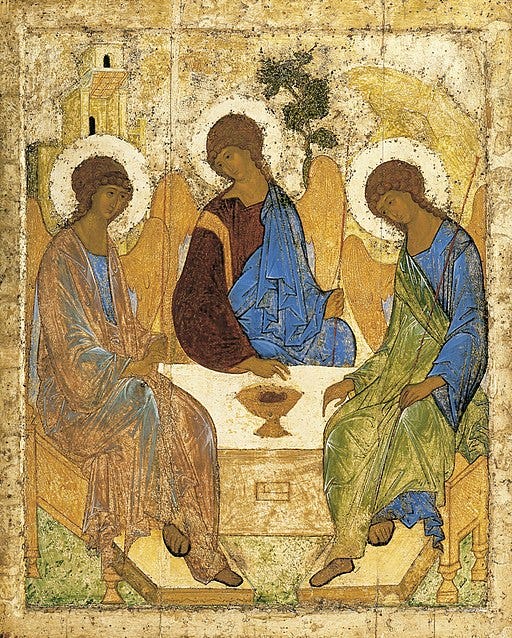
This is why Orthodox iconography matters so much. Look at Rublev’s icon of the Hospitality of Abraham—the gold standard for depicting the Trinity. All three Persons appear identical in form. They’re distinguished by the colors of their garments (which indicate relationship and role), not by gender presentation. There’s no “masculine Father” versus “feminine Spirit.” Actually, the three figures are angelic —they are simply not gendered at all. Far more importantly than gender, they are consubstantial—one essence, three persons.
As I wrote in the text of the meditation: “It is ludicrous to imply that this unknowable essence is masculine as opposed to feminine, or includes masculinity in such as way as to exclude the feminine.”
God the Father isn’t “not feminine”—He’s beyond the categories entirely. The essence of God is unknowable, prior to all distinctions including gender. When we use the language of Father and Son, we’re describing the internal relationships of the Trinity, not gendering the cosmos.
And here’s the kicker: Just a few days from now, the Christmas Liturgy will proclaim to us that Christ the Son “is motherless on His father’s side and fatherless on His mother’s side.” Jesus has a human mother—Mary—and a divine Father. Both relationships are essential. Both are titled in relationship to Christ. This explicitly refuses to gender the Godhead while honoring the particular, embodied reality of the Incarnation.
The Ontological Hierarchy (from Turning Venom into Medicine)
Alex’s levels are brilliant, but let me show you how Orthodox Christianity maps this out. While Alex’s levels show us physical levels of reality, these levels show us something slightly different. Another slice from the rainbow of light, if you will.
Level 0: The Unknowable Essence of God
Beyond all categories, distinctions, and attributes. Alex’s critique can remind us of the importance of apophatic theology. We can’t say what God is, only what God is not. And one thing God emphatically is not? Gendered.
Level 1: Trinity as Persons in Relation
Father, Son, and Holy Spirit. Three hypostases (distinct persons) in one ousia (essence/substance). What distinguishes them is relationship, not gender. The Father begets, the Son is begotten, the Spirit proceeds. These are relational terms describing eternal, mutual self-giving love.
Level 2: Creation as Icon
Everything created reflects—fractally, imperfectly, partially—Trinitarian reality. Not because the universe is the Trinity, but because the Trinity is the source and pattern of all existence. Creation is iconing the Creator.
Level 3: Universal Human Nature
“Male and female He created them” (Genesis 1:27). Notice: both are made in God’s image. Not “males image God’s masculine side and females image His feminine side.” Both. Together. Equally. The image of God is the human capacity for relationship, love, creativity, and theosis (union with God).
Level 4: Particular Persons
This is where Orthodox Christianity gets really specific about what matters. Not your gender. Not your personality type. Not whether you’re “more masculine” or “more feminine.” What matters is that you are a unique, unrepeatable, eternal thought of God. Your particularity—the specific configuration of soul, body, conscious experience, gifts, struggles, context, calling, that makes you you—is what’s precious.
Level 5: Physical Sexual Dimorphism
Finally, way down here, we have male and female bodies. This is real. It matters. But it is not the organizing principle of reality itself. It’s one icon, but not a direct representation. We can use it as a model, but we err when we forget that a model is definitionally less than the reality it represents.
See the difference? Sexual dimorphism isn’t at the top as some cosmic law; it’s lower, as one particular way that embodied creatures can image relationality.
And Here’s Where We Part Ways, Gently
Alex doesn’t claim to speak from within the orthodox Christian tradition, so of course, we are going to differ. So while I agree that gendered energy frameworks are harmful, I don’t think we need to conclude that sexual difference doesn’t matter at all. Here’s the key that unlocks the prison.
Physical Sex Is An Icon, Not An Inconsequential Detail
Alex writes: “Sexual dimorphism is just one strategy among many, one that mammals happen to use.” True! But in Christian anthropology, that’s not the end of the story—it’s the beginning.
Physical sexual difference—male and female—serves as an icon of otherness. It’s one of the primary ways we encounter the fundamental reality that we are not alone, not self-sufficient, not capable of creating new life through self-replication. We need the Other. We need someone who is genuinely, irreducibly different from us. This is why Alex is right that we can’t project sexual dimorphism onto fundamental cosmic forces—but we also can’t dismiss it as merely one evolutionary strategy among many. It points beyond itself to something true about personhood and communion.
As I wrote in my manuscript: “Our physical differences remind us of the Trinitarian truth that we are separate in a hypostatic way, and cannot dissolve into one another by achieving some kind of sameness.”
This isn’t about masculine energy versus feminine energy. It’s about the scandal of particularity—that communion requires distinct persons who don’t dissolve into each other. Male and female bodies are one way (not the only way, but a significant way) that creation teaches us this truth.
The Scandal of the Incarnation
Here’s the thing that neither New Age gender essentialism nor secular gender theory quite knows what to do with: Christ took on a particular male body in a particular time and place. Mary bore God in her particular female body.
These aren’t cosmic essences determining how all men and women must be. They’re historical particularities that carry theological weight precisely because they’re particular.
Christ isn’t male because masculinity is more divine than femininity. He’s male because the Incarnation required specificity—a specific time (first-century Palestine), a specific people (Israel), a specific body (male). The theological weight of His maleness comes from His fulfillment of Israel’s story (Davidic kingship, temple priesthood, suffering servant), not from some cosmic masculine principle.
Similarly, Mary’s femaleness matters not because receptivity is essentially feminine, but because she was the one who said yes, who bore God in her womb, who stood at the foot of the cross. Her particular body, her particular yes, her particular suffering—these are what we venerate.
Marriage As Icon (Not Cosmic Polarity)
This is where the modern framework, imported from an esotericism we didn’t realize we needed to examine, needs the Orthodox corrective most urgently. Because yes, absolutely, complementarian “divine masculine/feminine” polarity teachings in relationships are toxic. They create performances rather than persons, stereotypes rather than love.
But Orthodox Christianity has a different vision of marriage — and it’s not about masculine and feminine energies at all.
Marriage is a sacrament. Which means it’s a mystery that reveals something about reality that’s bigger and fuller than we can initially perceive. Specifically, it reveals three things:
Two distinct persons (hypostases) who remain distinct
Becoming one (consubstantial) without losing their particularity
United by and in God as the third member of the union
See? It’s Trinitarian. Not masculine/feminine polarity, but the same pattern as the Trinity itself—distinct persons in perfect communion.
The telos of marriage isn’t “masculine provides structure and feminine flows” or “masculine gives while feminine receives.” It’s two particular people learning to love like God loves—which requires both people to access the full range of human capacities (boundaries and openness, action and rest, giving and receiving) as each situation demands.
Reclaiming Husbandry Without Essentialism
Now here’s where it gets really practical, because I think there is a way to honor different roles and responsibilities in relationships—including between spouses—without falling into gender essentialism. And the guide here is Wendell Berry.
In his essay “Renewing Husbandry,” Berry describes husbandry and housewifery not as gendered essences but as ecological relationships. Husbandry is the outward-facing work that connects the household to land and community. Housewifery is the inward-facing work that deepens connections within the household.
And here’s the key: Berry explicitly says these aren’t gender-exclusive! A woman might be out in the fields at harvest; a man might be cooking dinner. These roles are context-dependent, place-specific, and intermingled in practice.
This is what spiritual gender can look like without essentialism: Not “men are naturally X and women are naturally Y,” but “in this particular household, in this particular place, at this particular moment, these are the forms our mutual service takes.”
Using the framework from Philip Mamalakis and Timothy G. Patitsas that I cite in Venom: every person—regardless of biological sex—fulfills three vocations as an icon of Christ:
Priest (connecting to God and mediating His presence)
King (leading, protecting, providing structure)
Prophet (discerning, intuiting, revealing truth)
These aren’t gendered. They’re universal human capacities that we all need to develop. The ecologically, relationally masculine “incensive power” (king) and the ecologically, relationally feminine “appetitive/desiderative power” (prophet) exist in all of us, chiastically, unified by our primary vocation as priests who submit our whole selves to God.
Here’s a nutshell for you (Can we still use bullet points? And em-dashes?):
What Alex Gets Right That Orthodox Christians Embrace:
✓ Don’t perform gender stereotypes in relationships
✓ Don’t reduce yourself to your reproductive organs
✓ Don’t assume your body determines your personality traits
✓ Don’t spiritualize inequality or patriarchy
✓ Don’t divide universal human capacities into “masculine” and “feminine” boxes
What Orthodox Christianity Adds:
✓ Your body is a gift and a task—neither inconsequential nor determining
✓ Sexual difference invites you into particular forms of self-gift without prescribing personality
✓ Chastity isn’t about performing gender; it’s about ordering eros toward God first
✓ Marriage isn’t about polarity; it’s about two particular persons learning Trinitarian love
✓ The full range of human capacities belongs to all humans, but we each have unique configurations
Breathing Together
Alex ends his piece with the image of breathing—inhale and exhale, expansion and contraction, a rhythm that every human participates in regardless of gender. It’s a perfect image, one I love to meditate on especially while swimming laps.
When you inhale, you’re not “accessing your feminine energy.” When you exhale, you’re not “stepping into your masculine power.” You’re just breathing—participating in the universal rhythm of life that predates gender and will outlast it.
Here’s what Orthodox Christianity clarifies about that image: You’re not breathing alone. You’re breathing in a world that’s breathing with you. Every creature, every leaf, every wave of the ocean—all participating in the same rhythm of give and take, receive and release.
And more: You’re breathing in God, who is everywhere present and fills all things. The very air you breathe is charged with divine presence. Every inhale is receiving God; every exhale is offering yourself back to Him. This is the experience of the breath of the Jesus Prayer.
This is what it means to live in an enchanted cosmos—not because we’ve projected our gender onto the universe, but because we’ve recognized that all of creation is participating in one great act of worship, one cosmic liturgy, one eternal exchange of love.
The divine masculine and divine feminine? They’re just echoes of what we’ve always known but sometimes forget: that reality operates through relationship, through communion, through the eternal dance of distinct persons who remain themselves while giving themselves completely.
Or as we say in the Liturgy: “Let us commit ourselves and one another and our whole life to Christ our God.”
Not our masculine selves or our feminine selves. Our whole selves. Complete, complex, contradictory, glorious, struggling, particular human selves.
That’s the invitation. Not to perform a gender role, but to become a person. Not to access divine energies, but to become fully alive—which is, as St. Irenaeus said, the glory of God.
HALLELUJAH.